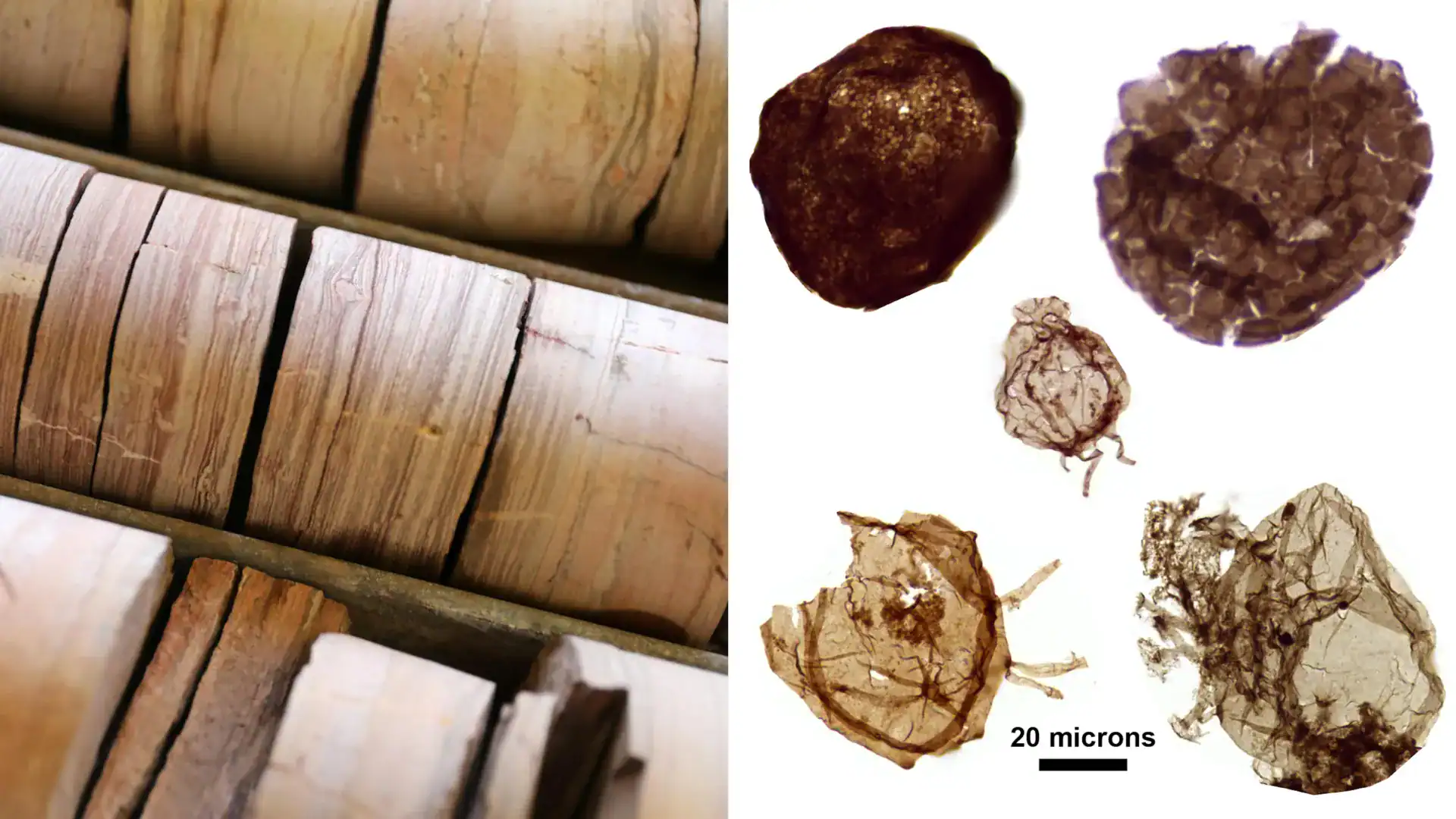
Saved in an open-air warehouse in tropical Darwin, Australia, are dozens of trays containing cylindrical cores of rock. They’re from drill holes bored tons of of metres under the floor by mineral exploration firms many years in the past.
A few of these cores on the Northern Territory Geological Survey are mudstone – a kind of sedimentary rock shaped from hardened seafloor mud. The businesses that drilled these cores have been largely unaware that inside these mudstones have been fossils of microscopic organisms buried on the seafloor of an historic inland sea that coated a lot of northern Australia over 1.5 billion years in the past.
As our new research, printed in Nature, exhibits, these fossils are essential for addressing a longstanding puzzle in regards to the main evolutionary leap that led to all advanced life on Earth: the origin of eukaryotes.
Small however advanced
All life on Earth could be positioned into one in all two sorts that are essentially completely different on the mobile degree.
Prokaryotes (micro organism and archaea) have easy mobile group and are principally single celled. Eukaryotes – together with all animals, vegetation, algae and fungi – are very completely different. They’ve way more sophisticated cells that includes a nucleus and different specialised buildings equivalent to organelles which carry out particular jobs.
The eukaryotic revolution reworked the planet. It led to the rise of animals and, finally, to us. Primarily based on observations from the genes of dwelling organisms, it’s now broadly agreed that the final widespread ancestor of all dwelling eukaryotes resulted from the symbiotic union of (not less than) two prokaryotic microbes: an archaeon and a bacterium.
The primary proof for eukaryotic life comes within the type of these fossils of single-celled organisms. They present a degree of mobile complexity not seen amongst prokaryotes, however widespread in eukaryotes.
Eukaryote fossils could be discovered round the world in rocks relationship again not less than 1.5 billion years. The fossils of the Northern Territory, the oldest of which date again to 1.75 billion years in the past, are the oldest at present recognized eukaryote fossils globally.
However the historic world through which early eukaryotes advanced stays shrouded in thriller. And so many elementary facets relating to their nature are unknown.
Oxygen – good friend or foe?
Many kinds of micro organism can reside and develop in locations with out oxygen. However almost all eukaryotes alive immediately use oxygen for his or her survival. That’s as a result of cardio respiration – breaking down meals utilizing oxygen – gives the huge quantities of power that advanced life calls for.
However the concept that oxygen has at all times been helpful for all eukaryotes has come beneath fireplace lately. This follows the stunning discoveries of enigmatic eukaryotes that may thrive in circumstances with out oxygen.
There’s additionally mounting proof from the geological document that when eukaryotes have been first evolving, oxygen was doubtless a lot scarcer. This implies oxygen-free marine habitats would have been the norm. Collectively, these observations have known as into query the idea eukaryotes have relied on oxygen since their inception.
Genetic research of dwelling microbes belonging to teams thought of closest to the ancestors of the primary eukaryote can supply key insights into eukaryote ancestry. However solely the fossil document can inform us about long-extinct lineages. And solely geology can supply a window into the form of world these organisms lived in.
Greater than 12,000 fossils
For our new research, we crushed up samples of the mudstone cores saved in Darwin, then dissolved them. We recognized greater than 12,000 fossils by analysing the natural residue left behind by this dissolution beneath a microscope.
We additionally studied the mudstones the fossils have been preserved in to higher perceive what the surroundings was like when the sediments have been deposited. This provided perception in regards to the habitats through which these eukaryotes lived. And by analysing the chemistry of those mudstones, we may decide whether or not oxygen was current within the historic seawater.
Our outcomes present that eukaryote fossils have been present in environments starting from coastal mudflats to the open sea. However they have been current solely in samples deposited in oxygenated settings. Samples from oxygen-free environments contained solely easy, prokaryotic varieties.
This implies that even the oldest recognized eukaryotes that lived on Earth 1.7 to 1.4 billion years in the past have been depending on oxygen. These information lend assist to a long-held speculation that oxygen performed a key function in driving the evolution of early eukaryotes.
Resolving the drivers and context of the most important evolutionary leap represented by early eukaryotes is likely one of the main excellent questions within the life sciences. Ongoing research of those enigmatic, historic microfossils will little question inform us extra about our personal origins – and our place within the cosmos.
Initially printed by www.sciencedaily.com.
Leave a Reply