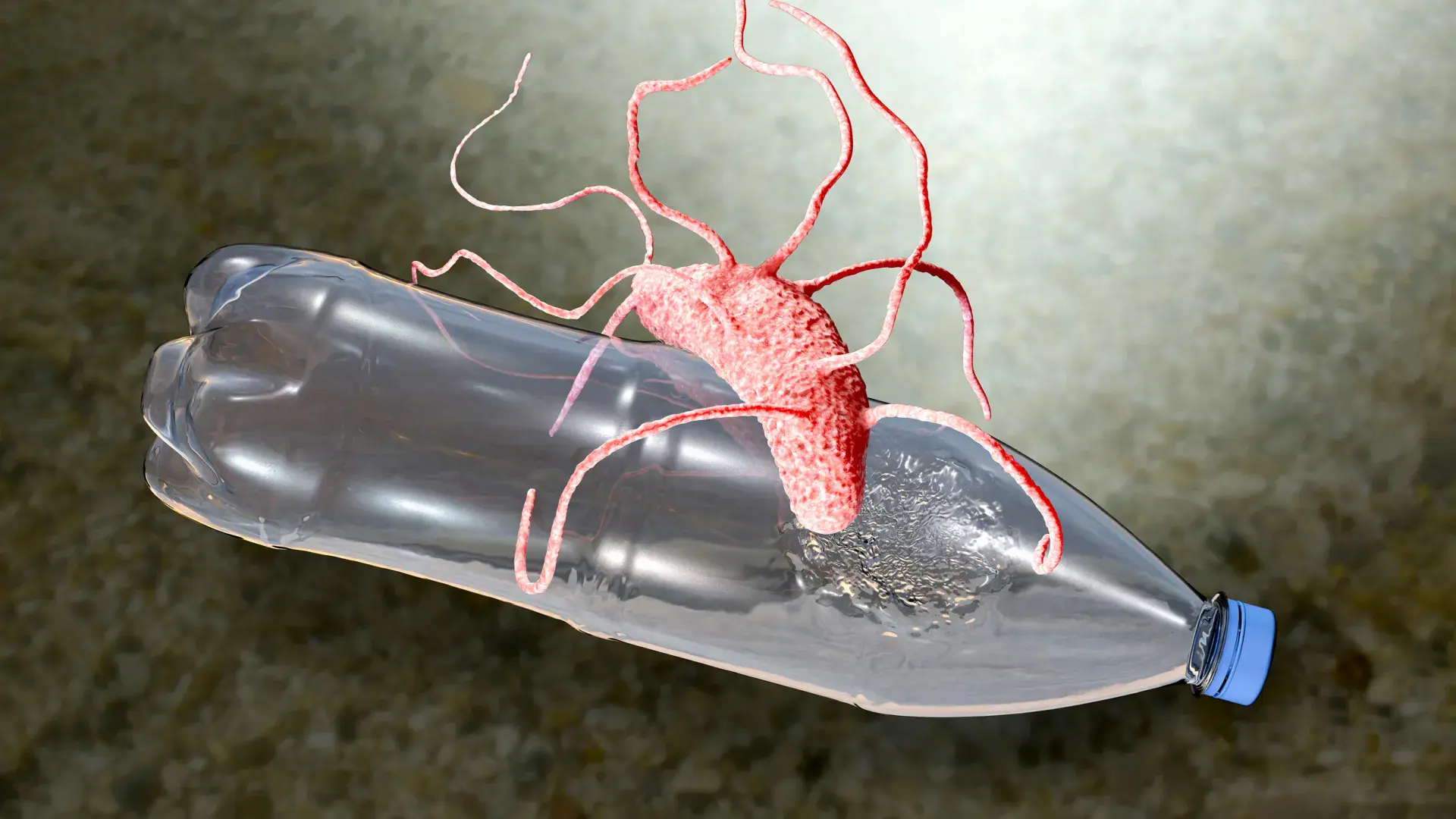
Plastic air pollution is likely one of the world’s most persistent environmental issues. Huge quantities of discarded plastic accumulate within the oceans, typically forming huge rubbish patches that threaten marine life. Most standard plastics break down extraordinarily slowly as a result of microorganisms wrestle to digest the artificial polymers from which they’re made. As a substitute of disappearing, these supplies regularly fragment into more and more smaller particles, together with microplastics and nanoplastics.
But plastic waste shouldn’t be fully past the attain of nature. Micro organism and different microorganisms can colonize its surfaces, forming communities often known as biofilms. These communities create a particular microbial ecosystem that scientists name the “plastisphere.”
Researchers on the College of Konstanz have now found an uncommon enzyme that might reveal how some micro organism have gotten higher outfitted to interrupt down sure kinds of plastic. The enzyme can digest specific polyesters and biodegradable plastics, nevertheless it has one other sudden means: it could additionally break down penicillin, suggesting a attainable connection to antibiotic resistance.
Scientists have nicknamed it the “Pac-Man enzyme” as a result of its molecular construction encompasses a remarkably broad opening the place chemical reactions happen, often known as the energetic web site. The invention means that micro organism could also be adapting to digest sure plastic supplies extra shortly than researchers beforehand believed.
Nonetheless, the findings additionally spotlight an vital limitation. For microorganisms to make a significant distinction in decreasing plastic air pollution, extra plastic merchandise would have to be constructed from biodegradable supplies that comprise chemical bonds microbes can break aside.
Testing How Micro organism Break Down Bioplastics
To research how microorganisms digest biodegradable plastics, College of Konstanz biologists Harry Lerner and David Schleheck studied your entire technique of microbial decomposition. They wished to find out not solely whether or not the supplies might be fully damaged down, but in addition which microorganisms had been accountable and what organic mechanisms allowed them to do it.
The researchers examined the composition of the microbial communities concerned and analyzed their collective genetic data (the metagenome). This method allowed them to seek for genes which may produce enzymes able to breaking up plastic polymers.
Their experiments centered on long-chain aliphatic polyesters (LCAP), a category of biodegradable plastic supplies developed by a analysis workforce led by chemist Stefan Mecking. These supplies comprise chemical bonds that sure microorganisms can doubtlessly break down, not like the extra resistant buildings discovered in lots of standard plastics.
The collaborative findings had been revealed in The ISME Journal.
To look at how the bioplastics behaved in a pure surroundings, the workforce positioned samples beneath the floor of forest soil on the college’s botanical backyard.
“We buried small items of LCAP bioplastic movie within the higher humus layer within the forest on the college’s botanical backyard, about ten centimeters deep,” explains Harry Lerner.
“This layer is the place the breakdown of cellulose and different pure polymers, akin to cutin – a plant-based polyester – takes place.”
Humus is the higher layer of soil wealthy in decomposing natural matter, the place microorganisms play a serious position in recycling vitamins. Cellulose is the principle structural element of plant cell partitions, whereas cutin is a naturally occurring polyester that helps type the protecting outer overlaying of vegetation.
The researchers chosen this surroundings as a result of its microorganisms already possess the organic equipment wanted to interrupt down advanced pure supplies.
Bioplastics Disappeared Inside A couple of 12 months
Alongside the out of doors experiment, the scientists carried out laboratory exams utilizing soil collected from the identical forest. They blended powdered bioplastics into the soil and monitored microbial exercise over the course of a complete yr.
One vital measurement was the quantity of carbon dioxide, or CO2, launched from the samples. As microorganisms eat and metabolize natural supplies, they produce carbon dioxide via respiration. Monitoring this gasoline helped the researchers decide how actively the microbes had been breaking down the plastics.
The buried plastic movies remained within the forest soil for a full yr, permitting the workforce to check decomposition beneath pure situations with the rigorously monitored laboratory experiments.
To evaluate the outcomes, the scientists additionally examined cellulose, different biodegradable plastics, standard polyethylene plastic, and soil samples with out added supplies.
“Cellulose, different kinds of bioplastics akin to PHBV and PCL, in addition to high-density plastic (HDPE) and untreated soil had been used as controls within the laboratory. We discovered that each one bioplastic supplies had been fully degraded inside roughly 250 to 330 days. Cellulose broke down after about 80 days, whereas just about no degradation occurred for HDPE,” says Lerner.
The distinction was placing. Whereas the biodegradable plastics had been fully damaged down inside roughly 9 to eleven months, standard high-density polyethylene confirmed nearly no decomposition.
These outcomes display why the chemical make-up of plastic issues a lot. Some polymers comprise bonds that microbial enzymes can assault, permitting micro organism to dismantle them into smaller molecules. Others, together with extensively used polyethylene, are much more proof against organic degradation.
Mysterious Holes Reveal How Micro organism Eat Plastic
When the researchers recovered the plastic movies from the forest soil, they found one thing sudden.
Utilizing electron microscopy, which may reveal buildings far too small to see with an extraordinary gentle microscope, the workforce examined the surfaces of the buried supplies. They discovered quite a few tiny holes, every roughly matching the size and form of a person bacterial cell.
The weird sample steered that micro organism had been doing greater than merely attaching themselves to the plastic. They seemed to be breaking into the fabric itself.
“We hypothesized that micro organism are coated with plastic-depolymerases anchored to their cell surfaces. This is able to allow them to digest their means into the fabric and turn out to be embedded throughout the movie, forsaking microscopic holes of precisely this sort,” explains Lerner.
Depolymerases are enzymes that break massive molecules referred to as polymers into smaller chemical models. If these enzymes are connected on to the surface of a bacterium, they may permit the microorganism to digest the encompassing materials whereas remaining in shut contact with it.
This is able to assist clarify the microscopic cavities noticed within the plastic movies. Somewhat than relying fully on enzymes launched into the surroundings, the micro organism may be capable of break down the fabric immediately at their surfaces.
Scientists Establish the Plastic-Consuming “Pac-Man Enzyme”
To seek out the organic equipment behind this uncommon conduct, Lerner extracted DNA from your entire group of microorganisms dwelling within the soil samples.
He then sequenced the genetic materials and punctiliously analyzed the in depth information to find out which microbes and genes turned particularly plentiful because the bioplastics decomposed.
One gene stood out. It was strongly enriched particularly in forest soil containing LCAP, suggesting that it may play an vital position in breaking down the biodegradable polyester.
Additional evaluation revealed that the gene produces an esterase, a sort of enzyme able to splitting sure chemical bonds present in esters. These bonds are current in lots of naturally occurring substances in addition to in varied biodegradable polyesters.
What made this specific enzyme particularly attention-grabbing was the way it was positioned on bacterial cells.
Its genetic directions included a secretion sign that directs the enzyme outdoors the cell, together with a lipid anchor that holds it firmly to the cell membrane.
This association means the enzyme can stay connected to the bacterium’s floor whereas attacking close by plastic molecules. Its unusually uncovered energetic web site additionally supplies area for the enzyme to work together with polymer chains.
The researchers had recognized the molecular mechanism they had been on the lookout for, together with the enzyme they named “Pac-Man.”
A Stunning Connection to Antibiotic Resistance
The invention turned much more intriguing when scientists examined the enzyme’s molecular construction.
Though it resembled esterases, that are identified for breaking down ester bonds, it additionally shared structural similarities with one other vital household of bacterial enzymes: beta-lactamases.
These enzymes are well-known for his or her position in antibiotic resistance. Some micro organism produce beta-lactamases that disable antibiotics akin to penicillin by breaking open a essential a part of their chemical construction, often known as the beta-lactam ring.
“Its construction resembles that of esterases, but in addition that of beta-lactamases, that are bacterial enzymes which might be able to cleaving the beta-lactam ring of sure antibiotics, akin to penicillin, thereby making micro organism proof against antibiotics,” says Lerner.
Laboratory experiments confirmed that the newly found enzyme was able to performing each kinds of chemical reactions.
It may break polyester chains into their particular person constructing blocks, often known as monomers, whereas additionally cleaving penicillin.
This twin exercise was significantly stunning as a result of plastic degradation and antibiotic breakdown are normally thought-about separate organic features.
The discovering raises the likelihood that some enzymes concerned in plastic decomposition may additionally contribute to antibiotic resistance. Nonetheless, demonstrating that an enzyme can chemically break down penicillin within the laboratory doesn’t set up that it supplies antibiotic resistance to dwelling micro organism.
Might Plastic-Consuming Micro organism Assist Remedy Plastic Air pollution?
The invention additionally raises a broader query about how quickly microorganisms can adapt to artificial supplies launched into their surroundings.
For many of Earth’s historical past, plastic air pollution didn’t exist. Microorganisms advanced enzymes to digest naturally occurring substances, together with plant fibers and different advanced natural molecules.
Trendy plastics have launched an infinite new assortment of potential carbon sources into the surroundings, however many of those supplies stay chemically inaccessible to microbes.
“The plastisphere is a brand new habitat in our surroundings,” explains Schleheck.
“People have solely been introducing plastic into the surroundings in vital portions for round 50 to 75 years. Since then, it has theoretically been obtainable to microbial communities – akin to micro organism, yeasts and fungi – as an extra supply of carbon and power for his or her progress. By ‘theoretically’, I imply that they would definitely like to make use of the plastic as a progress substrate – however they can not, as a result of the supplies are literally indigestible to microbial metabolism and are subsequently hardly degraded.”
The Pac-Man enzyme means that this barrier is probably not absolute for each kind of plastic.
Some micro organism seem able to utilizing specialised enzymes to assault biodegradable polyesters, doubtlessly permitting them to take advantage of these supplies as sources of power and vitamins.
For scientists learning plastic air pollution, the discovering presents a promising clue about how organic degradation may be improved. It additionally means that microbial communities might be adapting to sure artificial polymers extra quickly than beforehand anticipated.
Nonetheless, the outcomes don’t imply that micro organism are abruptly able to consuming the large quantities of standard plastic already accumulating within the surroundings. The experiments confirmed that polyethylene remained largely unaffected, even because the biodegradable plastics decomposed.
As a substitute, the researchers emphasize the significance of designing supplies that microorganisms can truly digest.
“I discover this encouraging, as a result of evidently micro organism can adapt to breaking down polyester plastics extra shortly than we anticipated. To deal with the environmental downside of plastic air pollution, we people have to work with the capabilities of microbes. Ideally, this might contain utilizing solely polymers with biochemical breaking factors, such because the hydrolysable ester bonds in polyesters like LCAP or different kinds of bioplastics,” concludes Schleheck.
The invention presents a glimpse of a doubtlessly extra sustainable method to plastic manufacturing. Somewhat than anticipating microorganisms to interrupt down supplies which might be naturally proof against decomposition, scientists may develop plastics with chemical buildings that make organic recycling attainable.
The Pac-Man enzyme illustrates how micro organism can exploit these molecular weak factors, providing new perception into the connection between plastic air pollution, microbial adaptation, and the way forward for biodegradable supplies.
Initially revealed by www.sciencedaily.com.
Leave a Reply