
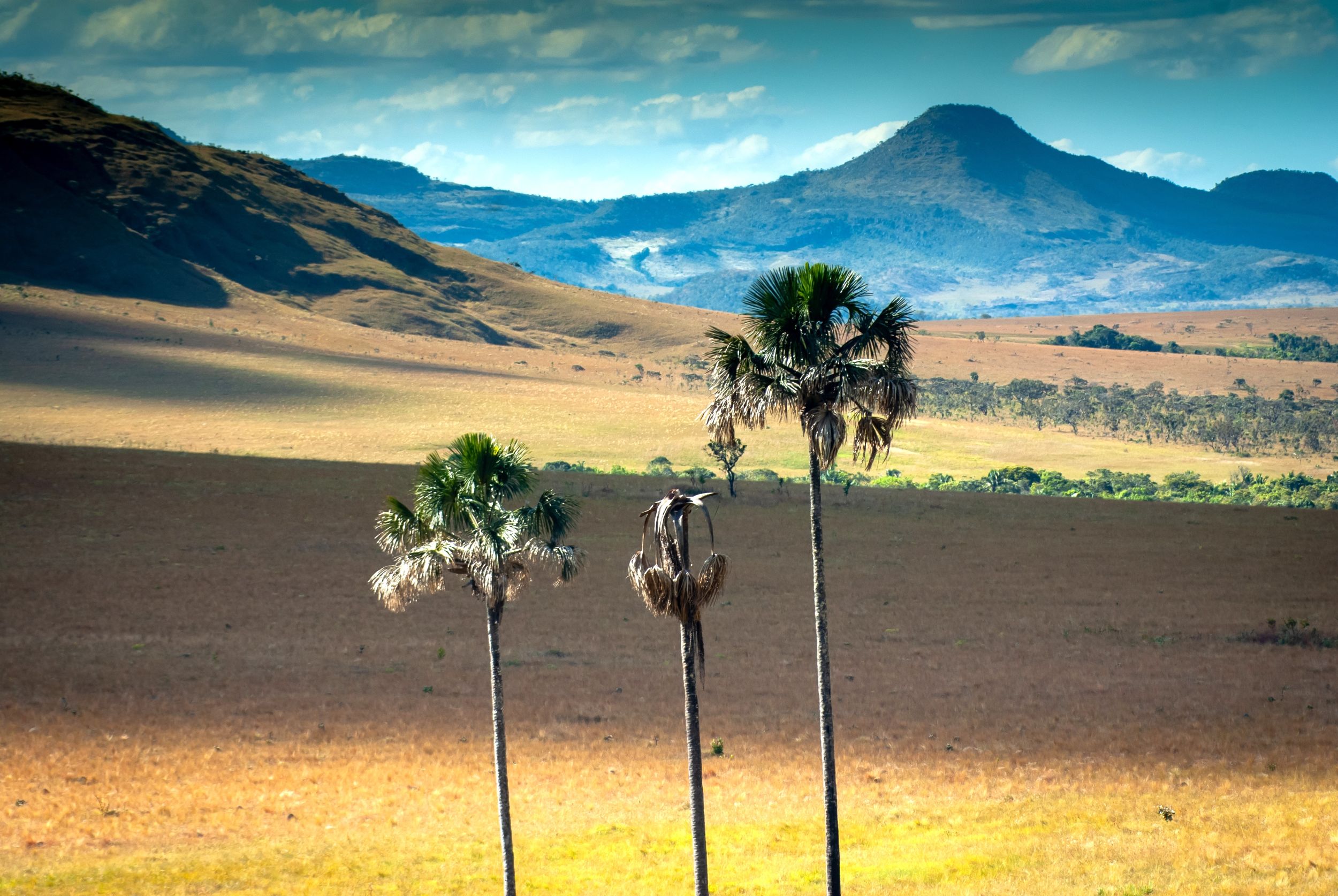
Scientists warn that grasslands and savannas store enormous amounts of carbon underground, yet climate policies largely overlook these vital ecosystems.
Forests dominate climate policy. They get the funding, the carbon credits, the UN programs, the satellite monitoring.
Grasslands, savannas, and shrublands get almost none of it. A new policy brief argues that this blind spot is not just scientifically unjustified, but actively dangerous.
The research was led by Franciele Peixoto, an environmental analyst for the state of Goiás in Brazil.
Peixoto collaborated with Natashi Pilon, a plant ecologist at the State University of Campinas, and Amy Zanne, an ecologist at the Cary Institute of Ecosystem Studies.
The study grew out of a brief the team presented at COP30 in Brazil, where, as Peixoto put it, “nobody was talking about open ecosystems and the importance of these areas for carbon storage.”
Belowground carbon in the Cerrado
The case the authors make centers on Brazil’s Cerrado, the most biodiverse savanna in the world. This savanna is home to more than ten thousand plant species and over a thousand animal species.
In some of the Cerrado’s wetlands, soils store around 1,200 tons of carbon per hectare.
That is approximately six times the carbon stored in the vegetation of a typical Amazon rainforest.
The distinction matters enormously. Much of the Amazon’s aboveground carbon is stored in trees, while the Cerrado holds enormous reserves belowground.
Cerrado soil carbon has been accumulating for as long as 20,000 years. Destroy it, and it does not come back on any timescale relevant to climate policy.
Water security in Brazil
The Cerrado also feeds the rivers. It serves as headwaters for two-thirds of Brazil’s major waterways, including the Amazon itself.
Because the vegetation is lower and less dense than forest, more rainfall infiltrates the soil rather than being transpired back into the atmosphere.
This replenishes groundwater that sustains not only the Cerrado but surrounding biomes too.
“People tend to think of forests as being important for the water supply, but actually, open ecosystems can be as or even more important,” Pilon said.
“It is important that society and the government understand how important the Cerrado is for Brazil’s water security.”
A legacy written into carbon markets
Despite all of this, open grasslands and savannas remain largely overlooked by major climate finance programs, including REDD+, a UN framework that rewards developing countries for protecting forests.
Many measurement and certification frameworks were designed around forests, leaving the deep soil carbon and root systems of open ecosystems poorly represented. This oversight has deep historical roots.
“When the Europeans were mapping the land in Brazil, the forests were ‘good’ because they had wood, but in the Cerrado, it was difficult to produce food without Indigenous knowledge or modern technology, fires would happen, and the trees were smaller and twisted – so they considered it a wasteland,” Pilon explained.
That colonial judgment is still embedded in global policy today.
The consequences have been severe. Over 46% of the Cerrado’s original land cover has already been cleared for crops and pasture.
The savanna is treated as expendable – the biome that can be converted so the Amazon doesn’t have to be.
“In Brazil, the Cerrado is considered the biome that can be sacrificed to protect the Amazon,” Zanne said.
“So instead of cutting down more rainforest, agribusinesses are converting massive amounts of Cerrado to grow soybeans to feed to livestock – without realizing that they’re going to lose the Amazon by drying out these biomes.”
Why planting trees can make things worse
One of the more counterintuitive arguments in the study concerns reforestation.
Well-intentioned tree-planting schemes, applied to open ecosystems, can cause more harm than the degradation they are meant to repair.
“It is also essential to protect these areas from tree-planting projects, which may be well-intentioned but threaten the region’s water supply, biodiversity, and carbon stocks,” said Pilon.
What needs to change
The authors call for carbon credit methodologies to be rewritten to include belowground carbon.
They want Brazil to create and fund national legislation specifically covering open ecosystem management, monitoring, and restoration, and to incorporate these landscapes into national climate and biodiversity targets.
There are early signs of progress, with open ecosystems beginning to receive more attention in international climate discussions.
After the team and their collaborators successfully brought the issue to the agenda at COP16, Brazil’s Ministry of the Environment established a working group to develop a national conservation and restoration strategy.
“All of the standards and methods for carbon markets are based on forested areas, so there is no way right now to include grasslands, savannas, and other open ecosystems,” Peixoto said.
“Transforming a global system that was not designed to account for open ecosystems will not happen overnight. What matters now is moving from awareness to action.”
The carbon is already there, locked in soils that took millennia to build. The question is whether climate policy will recognize it before those soils are gone.
The study is published in the journal Plants, People, Planet.
—
Like what you read? Subscribe to our newsletter for engaging articles, exclusive content, and the latest updates.
Check us out on EarthSnap, a free app brought to you by Eric Ralls and Earth.com.
——-
Originally published by www.earth.com.
Leave a Reply