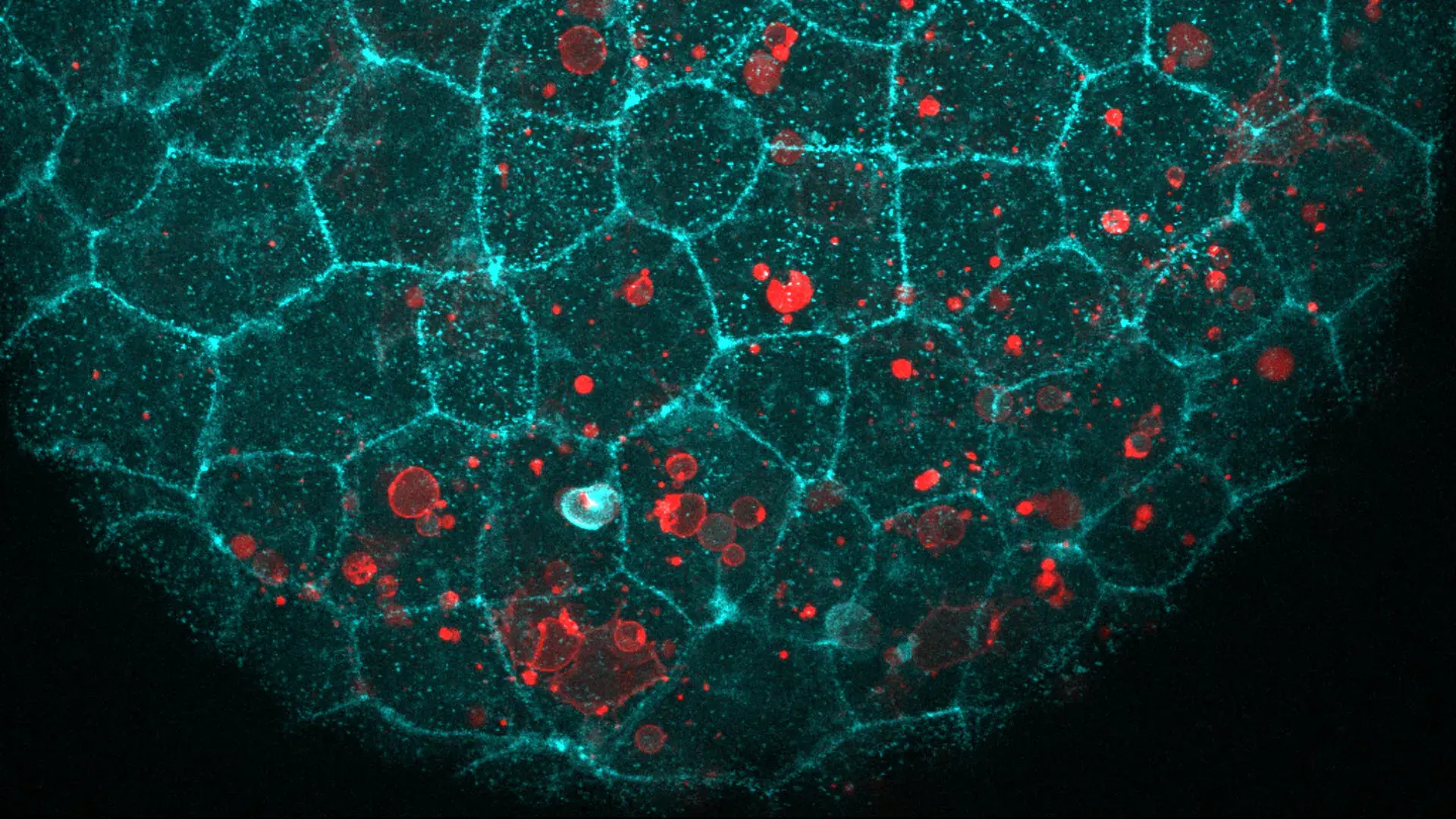
A protein finest recognized for serving to cells and tissues keep related has one other surprising function. Researchers have discovered that it additionally helps epithelial cells, which type steady sealed layers all through the physique, engulf close by useless cells.
The invention may have implications for continual irritation. Particles from dying cells is a significant contributor to inflammatory responses, so understanding how tissues take away that materials could reveal new clues about what occurs when the cleanup course of fails.
The examine, printed in Nature Communications, focuses on the E-cadherin complicated. This molecular system consists of E-cadherin together with three extra proteins. Collectively, they join epithelial cells lining areas such because the pores and skin, intestine and airways, giving tissues the structural power they should stay intact. In these tissues, every cell connects to E-cadherin molecules on neighboring cells.
Mobile Glue Takes on a Cleanup Position
A workforce led by Verena Ruprecht examined epithelial tissues in dwelling zebrafish and mouse embryos. They discovered that the identical molecular equipment additionally gathers on the actual location the place a dying cell comes into contact with the tissue.
The researchers needed to know whether or not E-cadherin and its companions have been attaching to the dying cell in the identical approach they usually connect neighboring epithelial cells. To check that chance, they carried out two experiments.
First, they introduced the tissue with dying cells that had been stripped of E-cadherin. The epithelial tissue eliminated these cells simply as successfully because it eliminated regular dying cells. Subsequent, the workforce launched fats droplets that contained no protein in any respect however carried a sign usually displayed on the floor of dying cells. The epithelial cells engulfed these droplets as nicely.
“We have been intrigued to search out out that epithelial cells repurpose their molecular adhesion equipment — the ‘glue’ that usually holds them collectively — to engulf dying cells,” says ICREA Analysis Professor Verena Ruprecht, senior writer of the examine.
How Cells Eat With out Breaking the Barrier
Engulfing one thing roughly the dimensions of one other cell presents a tough mechanical drawback. Epithelial cells are tightly packed into obstacles that always want to stay sealed, even whereas particular person cells reshape themselves to take away particles.
Stay imaging revealed how they accomplish this. The higher and decrease surfaces of the identical epithelial cell can behave in another way from each other. The decrease floor stretches and bends across the useless cell, whereas the other facet stays comparatively unchanged.
That higher floor, which can face the surface atmosphere or an open area akin to the within of a lumen, continues sustaining the tissue barrier. Measurements taken earlier than, throughout and after engulfment confirmed that the realm of the higher floor modified little or no. In contrast, the decrease floor underwent substantial deformation through the ‘consuming’ course of.
Ruprecht compares the conduct to a row of dancers standing with their arms linked. Their higher our bodies stay regular whereas their toes carry out more and more difficult actions when a dying cell seems. “It is the identical dancer with a unique choreography,” she says.
A Molecular Rope and Brake
The researchers additionally examined the mechanics that enable the cells to carry out this cleanup.
One protein within the E-cadherin complicated acted very like a rope. It related the molecular meeting to the cell’s inside skeleton, permitting power to be transmitted throughout the floor of the fabric being engulfed. When cells lacked this tethering protein, or lacked the precise area that attaches it to the skeleton, they might not swallow useless cells.
One other part behaved extra like a brake on the cell’s contractile equipment. Surprisingly, eradicating this brake didn’t make the cleanup course of simpler. As a substitute, the cell grew to become too stiff and misplaced its means to correctly take away dying cells.
The Similar Mechanism Seems in Mammals
The workforce subsequent investigated whether or not the method extends past zebrafish.
In early mouse embryos, blocking E-cadherin induced dying cells to stay uncleared. This matched the outcomes seen in zebrafish and means that the mechanism is shared amongst vertebrates.
The brand new work builds on earlier analysis from Ruprecht exhibiting that embryos can use epithelial tissues to cooperatively take away dying cells. That conduct represents a type of early innate immune protection.
Embryos are significantly helpful for finding out these occasions as a result of they’re clear. Researchers can observe dwelling cells and tissues instantly at a degree of element that can’t at the moment be achieved contained in the human physique.
Might the Similar Course of Work in Grownup Tissues?
An vital query stays unanswered. Researchers don’t but know whether or not this identical E-cadherin dependent mechanism operates in grownup zebrafish or mice, or in any kind of human tissue.
There are causes to assume it may. Epithelial tissues in adults are already recognized to take away dying cells in locations together with the retina, colon, airways and mammary gland. E-cadherin can also be discovered all through epithelial tissues within the physique, and its construction has remained remarkably related throughout species. These traits make it a robust candidate for a extra broadly used cleanup mechanism.
The potential medical significance comes from what can occur when useless cells aren’t eliminated effectively. Dying cells that stay in tissues can ultimately rupture and launch their contents, contributing to continual irritation.
The findings recommend that profitable cleanup relies on greater than receiving the right chemical sign to engulf apoptotic particles. Cells should even be bodily able to altering form, making use of power and wrapping round useless materials with out compromising themselves or the encompassing tissue.
“Finding out the mechanisms of how dying cells could be eliminated effectively from tissues is of very excessive relevance to human well being,” concludes Ruprecht.
The work was led by joint first authors Hanna-Maria Häkkinen, Marta Batet Palau and Laura F. Bianchi and supervised by Verena Ruprecht. It was funded by the Spanish Ministry of Science and Innovation, the Human Frontier Science Program, the European Union’s Horizon Europe program, and the “la Caixa” Basis, with extra assist from the European Social Fund. It made use of the CRG Core Services for Superior Gentle Microscopy, Tissue Engineering and Protein Applied sciences.
Initially printed by www.sciencedaily.com.