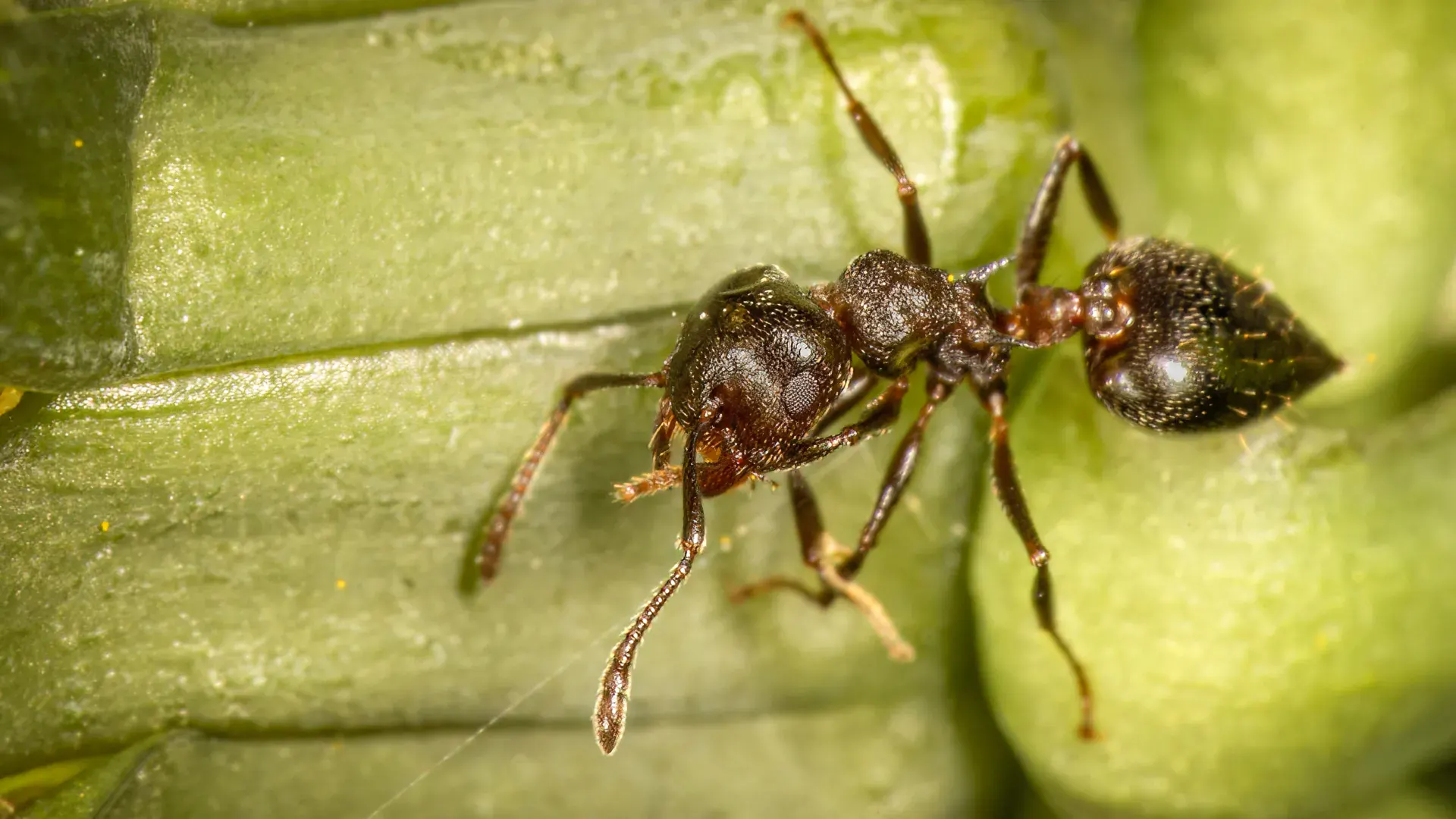
Scientists finding out the tropical forests of Malaysian Borneo have found an sudden shift in one of many area’s long-running ecological partnerships. A global group from Queen Mary College of London, the Royal Botanic Gardens, Kew, the Biology Middle of the Czech Academy of Sciences, and different establishments discovered that predatory wasps are more and more occupying the hole stems of the tropical plant Macaranga pearsonii.
The findings, revealed in PeerJ, reveal that the wasps are shifting into constructions that developed particularly to shelter protecting ant colonies.
For at the very least 10 million years, these “ant-plants” have maintained a detailed partnership with ants. The crops produce hole chambers the place ants can dwell and likewise provide them with nutritious meals our bodies. In change, the ants aggressively defend their host crops from leaf-eating bugs similar to caterpillars.
Now, researchers have discovered proof that this historic relationship is being disrupted.
Predatory Wasps Take Over Ant Shelters
The group examined younger Macaranga pearsonii bushes rising in each logged forests and oil palm plantations. When researchers dissected the crops, they found {that a} species of predatory wasp was utilizing the hole chambers for a wholly totally different objective.
Lead writer Mr. Lestina defined:
“Whereas surveying these ant-plants, I observed that many stems had been hollowed out in an uncommon means. Once we opened them, they had been filled with flies being eaten alive by wasp larvae. Grownup wasps hunt and paralyze the flies, then retailer them contained in the plant’s cavities as meals for his or her younger.”
Moderately than serving as properties for protecting ants, a few of the plant chambers had successfully change into nurseries stocked with prey for growing wasp larvae.
The researchers additionally discovered a powerful connection between wasp occupation and human-altered environments. Crops rising in oil palm plantations had been more likely to comprise wasps than these present in logged forest.
Bushes occupied by wasps additionally constantly had a lot smaller ant colonies. This sample raises the chance that the wasps are displacing the ants fully, though the researchers say experiments can be obligatory to verify whether or not that’s really taking place.
Habitat Disturbance Might Be Serving to Wasps Unfold
Co-author Dr. Kalsum M. Yusah defined:
“Human actions are remodeling habitats worldwide, and this sort of shift in species interactions is strictly what we anticipate to see. We do not but know whether or not this wasp is native or launched, however its unfold is clearly linked to disturbed landscapes.”
The findings might have implications past the ants, wasps, and particular person crops concerned.
Macaranga species are sometimes among the many first crops to determine themselves in areas which were cleared or broken. If shedding their ant defenders makes these crops much less wholesome, the consequences might doubtlessly affect the broader technique of forest regeneration.
“If the crops lose their ant defenders and change into much less wholesome, it might hinder forest restoration following disturbance,” Dr. Yusah added.
An Historic Partnership May Change Over Time
Senior writer Dr. Fayle from Queen Mary College of London stated the disruption might ultimately have evolutionary penalties.
“When mutualistic advantages break down, it could possibly drive long-term evolutionary change. If these constructions change into much less worthwhile to the crops as a result of wasps exploit them, the crops might cease investing in them. These delicate, long-term penalties of human exercise are far much less understood than simple biodiversity loss.”
The connection between ants and these tropical crops represents simply one among hundreds of tightly linked ecological partnerships present in tropical ecosystems.
If human disturbance makes it simpler for brand spanking new “invaders” to enter these relationships, even when these species are native, different mutualistic partnerships might additionally change into destabilized. That would weaken crops’ pure defenses and alter which species change into dominant inside tropical forests.
The findings provide an early warning that ecological techniques can start altering in delicate methods lengthy earlier than species disappear solely. On this case, the primary signal is unfolding contained in the hole stems of tropical crops, the place a partnership that has lasted thousands and thousands of years could also be beginning to come aside.
Initially revealed by www.sciencedaily.com.