
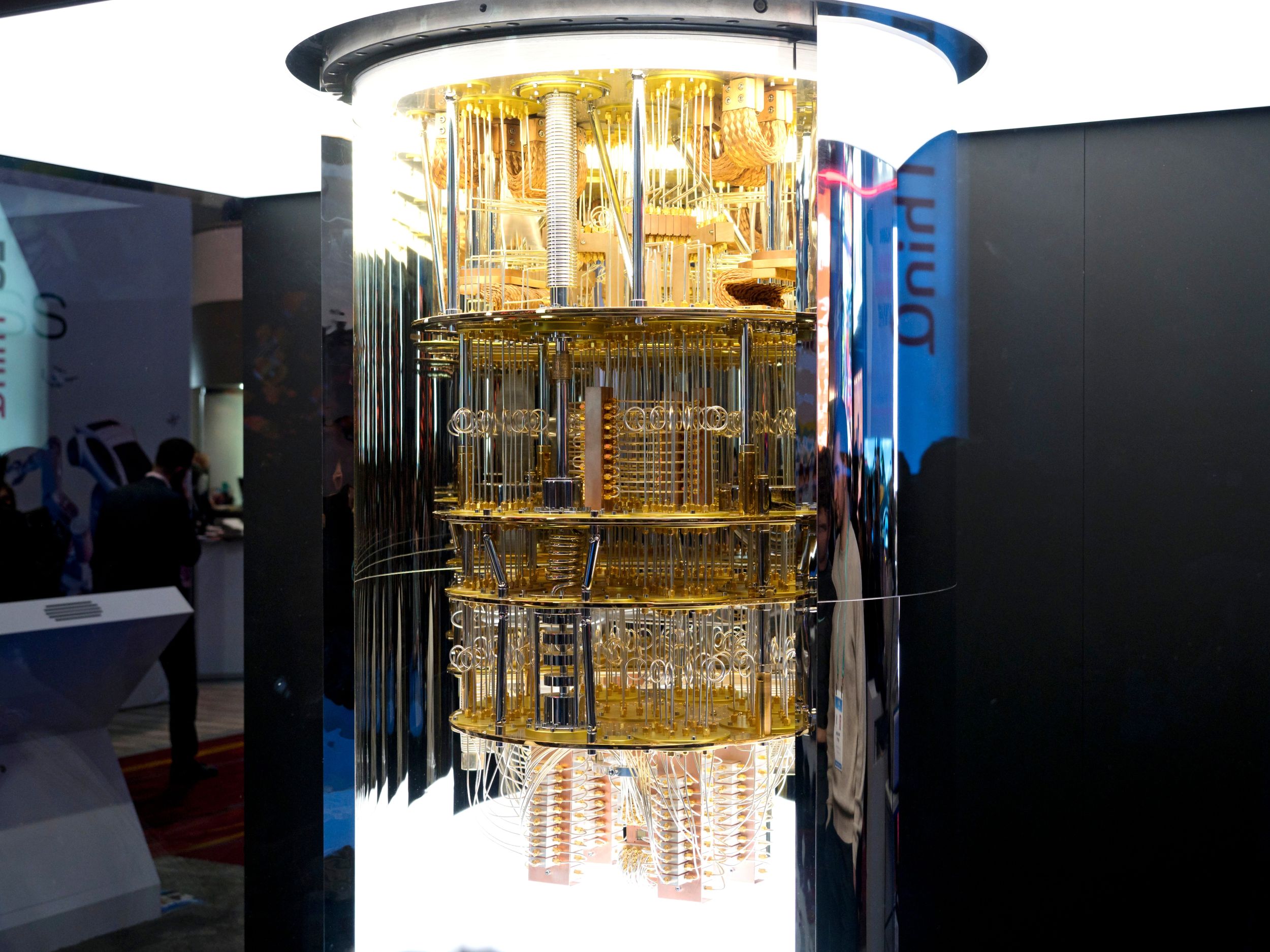
Scientists found a tipping level the place repeated measurements and resets can tame chaos inside a quantum pc, bringing dependable computing nearer.
The butterfly impact says a tiny nudge can develop into one thing practically not possible to foretell.
But chaos can typically be introduced beneath management by intervening typically sufficient, and a brand new experiment reveals that this precept additionally applies inside a quantum pc.
When researchers checked and reset its qubits typically sufficient whereas it ran, the machine switched abruptly from chaotic habits to a state they may steer.
A check-and-reset cycle like this one, repeated hundreds of instances with out stopping the work, is what future quantum computer systems might want to hold working regardless of their errors.
Researchers at Rutgers College and IBM led the work. Jedediah Pixley of Rutgers and Maika Takita of IBM have been senior authors.
The experiment wasn’t error correction itself, and large-scale, absolutely fault-tolerant quantum computer systems stay out of attain.
Qubits are simple to disturb
An extraordinary pc shops info in bits, every a 0 or a 1. A quantum pc makes use of qubits, which might maintain a mix of each prospects till somebody measures them.
This potential helps give quantum computer systems their potential energy, however their delicate quantum states are additionally simply disturbed.
Warmth, stray electrical indicators and tiny flaws within the {hardware} can all knock a qubit astray, and the errors add up till a calculation can’t be trusted.
Fixing these errors is unusually laborious. Quantum info can’t merely be copied, and measuring a qubit can change the very state the pc is utilizing.
“To construct a fault-tolerant quantum pc, we now have to make these checks and corrections not simply a couple of times, however an enormous variety of instances throughout a calculation,” stated Pixley, a physicist who can also be a member of the Flatiron Institute in New York.
Shuffling towards resetting
The mission began with a guess at a 2021 celebration for Pixley’s spouse.
His longtime collaborator Sriram Ganeshan argued {that a} puzzling quantum impact had a counterpart in extraordinary physics, and Pixley misplaced, paying in two scoops of blueberry ice cream.
Pixley’s staff later used IBM’s 156-qubit Heron processor and picked out a linked chain of as much as 100 qubits. Then that they had the machine flip between two jobs, chosen at random at every step.
One job scrambled info between neighboring qubits, very like shuffling a deck of playing cards.
The second checked one qubit and reset it to 0 when wanted, nudging the chain towards an orderly state of all zeros.
Throughout a full run, the processor carried out practically 5,000 operations linking pairs of qubits and practically 5,000 checks and resets.
Earlier experiments of this sort on quantum processors had run checks partway by a calculation on solely tens of qubits.
Stepping in to calm chaos already works in extraordinary physics. Nicely-timed pulses can cease harmful coronary heart rhythms, and small thrusts can information spacecraft alongside unstable paths.
“It wasn’t apparent that this transition between chaos and management would survive in quantum physics, however our outcomes present that it does,” stated Justin Wilson, a physicist at Louisiana State College and a co-author.
Management took over at midway
The researchers managed how typically the processor reset a qubit as an alternative of scrambling.
When scrambling occurred extra typically than resetting, chaotic habits dominated.
When checks and resets occurred extra typically, the chain settled towards the all-zero state.
The change got here at about 50-50. Within the experiment, the tipping level landed at 49.5% checks, in keeping with the staff’s theoretical predictions.
Physicists name a sudden, system-wide change like {that a} part transition. Earlier principle work had solely explored this one in pc simulations of as much as 24 qubits.
“What was hanging was that the transition turned extra clearly outlined as we studied bigger techniques,” stated Haining Pan, a co-first creator who was a postdoctoral researcher at Rutgers in the course of the examine.
Outcomes that seemed quantum
A loud machine might faux a few of these patterns with out doing something really quantum. To rule that out, the staff ran two sorts of simulation.
One stored the quantum results, and the opposite eliminated them.
Within the chaotic vary and on the tipping level, the quantum simulation matched the experiment extra intently, and that edge held because the techniques grew bigger.
Within the orderly vary, errors in studying out the qubits took over, and neither simulation matched the info nicely.
“This experiment reveals that present-day {hardware} can coordinate quantum operations, measurements and resets hundreds of instances throughout a big system,” Takita stated.
The highway to error correction
Pixley’s group examined the equipment that error correction wants, not error correction itself.
A full error-correcting pc must catch its errors quicker than they pile up. It might additionally want to try this over far longer calculations.
Readout errors additionally blurred the orderly facet of the outcomes. The staff’s fashions didn’t absolutely account for each supply of noise within the {hardware}.
Nonetheless to return is a check of whether or not the identical check-and-reset cycle can maintain up by the for much longer runs a helpful quantum pc will want.
The complete examine was printed within the journal Nature Physics.
—–
Like what you learn? Subscribe to our e-newsletter for partaking articles, unique content material, and the newest updates.
Examine us out on EarthSnap, a free app delivered to you by Eric Ralls and Earth.com.
—–
Initially printed by www.earth.com.